The Antechamber
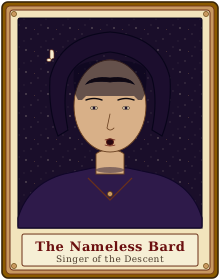
The gate is open. Before you descend, you must learn the names of the things that hunt in the dark.
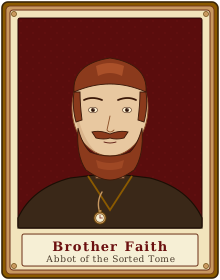
The Abbot greets you at the gate
The Antechamber. You will not be harmed here. Take this week and learn the names of the things below — list, stack, queue, set, map. The dungeon will not wait for your vocabulary.
The briefing
You stand in the Antechamber — the first room of the dungeon. Nothing threatens you here yet. Before you descend, you must learn the language of the dungeon: the names of the things that adventurers carry, the things they fight, and the way their efforts are measured.
This week, you learn three vocabularies:
- Abstract Data Types (ADTs) — the interfaces your adventurers use to organize loot, spells, and enemies. Every tool you’ll carry this semester is an instance of one of these.
- Abstraction & encapsulation — the discipline of keeping implementation details hidden behind those interfaces.
- Algorithm efficiency — an intuition for how costly an operation is as the dungeon grows. (Full Big-O follows on Floor 1.)
You will not implement anything new this week. You are being given a map of what’s coming.
Objectives
By the end of Floor 0 you will be able to:
- Define data structure, algorithm, and abstract data type in your own words.
- Name the common ADTs (list, stack, queue, deque, bag, set, priority queue, dictionary) and describe what operations each supports.
- Explain why two implementations of the same ADT can have very different performance.
- Estimate, informally, whether an algorithm’s cost grows slowly or quickly as input grows.
- Compile and run a C++ program on your machine (confirming your dev environment works).
Pre-class
Reading (ZyBook Ch. 1)
Before Monday: §1.1 Data structures, §1.2 Introduction to algorithms Before Wednesday: §1.3 Relation between data structures and algorithms, §1.4 Abstract data types, §1.5 Applications of ADTs Before Friday: §1.6 Algorithm efficiency
Work the Question Sets and Animations inside the ZyBook — they count toward your participation grade.
In-class (MWF)
| Day | Focus | Activity |
|---|---|---|
| M | Course entry, what is a DS? | Syllabus & dungeon tour; Unplugged ADT card activity; start dev environment setup (g++, editor, git) — finish before Wednesday |
| W | Common ADTs; first C++ syntax | ADT Triage — match scenarios to ADTs in pairs; live-code two tiny C++ scripts together (hello.cpp, vector_demo.cpp) so everyone has touched the compiler at least once |
| F | Algorithm efficiency, intuition | Race the dungeon — hand-trace two algorithms on inputs of size 10, 100, 1000; predict; then run a small growth.cpp sample together to see the numbers |
There are no pre-class videos this week. Class time is for setup, discussion, and live coding together.
Lab — folded into the project
Lab 0 — “First light.” No separate handout. The project task below is the lab: build, run, change one string, commit. By Friday you should have a working compiler, a clean clone, and one commit pushed.
Deliverable: a commit pushed to your project repo with your hero’s name set in main.cpp.
The project — Floor 0
This week’s project increment is environment-only. You will not implement any data structures yet. What you will do:
- Clone the starter.
- Build it with CMake (
cmake -B build && cmake --build build). - Run it. It prompts for your hero’s name and echoes a single line of dungeon flavor text.
- Change one string constant so the flavor text is yours.
- Commit and push.
Why so little? Because environment setup — compilers, paths, build tools — is the single most common reason students fall behind in week 1. We flush out those gremlins before we need to fight real ones.
Bestiary · Floor 0
The Compile Demon — HP: your patience.
Strikes when your code is fine but your environment isn’t. Symptoms: g++: command not found, 'cout' was not declared, linker errors with no line number. Counter by:
- Confirming your compiler is on your
PATH. #include <iostream>andusing namespace std;(orstd::cout).- Rebuilding from a clean state when mystery errors persist.
Check for understanding
Before you descend to Floor 1, you should be able to answer these without looking:
- In one sentence, what is the difference between a data structure and an abstract data type?
- Name three ADTs and, for each, name one real-world situation where it’s the right tool.
- If Algorithm A takes 1 ms on 100 inputs and 4 ms on 200 inputs, and Algorithm B takes 1 ms on 100 inputs and 100 ms on 1000 inputs — which one do you trust on a million inputs, and why?
- What does it mean to say a container is “encapsulated”?
- What command compiles
main.cppon your machine? Write it from memory.
Answers are discussed in the Monday Floor 1 warmup.
The Antechamber is quiet. The stair to Floor 1 is marked in the map. Rest well.