The Scrying Well

Every thing that lives in this Keep has a name. The Well will show you any of them — if you can find the name first.
The briefing
You descend the stair from the Antechamber into a circular stone chamber. In the center, set into the floor, is a black-water well — the Scrying Well. Whatever you name aloud, it shows you. A goblin’s stats. A spell’s effect. The shape of a beast you have not yet met.
Beside the well is a stone tablet — the Bestiary — listing every creature in the Keep. Without the Bestiary, you would have nothing to ask for. Without a way to look up a name in the Bestiary, the Bestiary is just a wall of dead words.

Scrivener McCown, Keeper of the Bestiary
Every creature in this Hold has a name. Every name is in this book — I wrote it. The Plague cannot touch what is already cataloged; that is why I returned, and why these pages are the most valuable thing in the monastery. If you meet a beast that is not listed, bring me its name.
This week you build the looking-up. By Friday your hero will be able to type search Goblin and have the goblin’s stats appear, instantly — and you will be able to measure how fast it is.
You will learn three ways to search:
- Linear search — start at the top, check every entry, stop when you find it. Always works. Slow when the Keep is full.
- Binary search (iterative) — keep cutting the remaining list in half. Blazingly fast. Only works on a sorted list, and the silent failure mode when the list isn’t sorted is one of the most dangerous bugs in this course.
- Binary search (recursive) — the same algorithm, expressed as a function that calls itself. Your first taste of the recursive thinking that will dominate the second half of the semester.
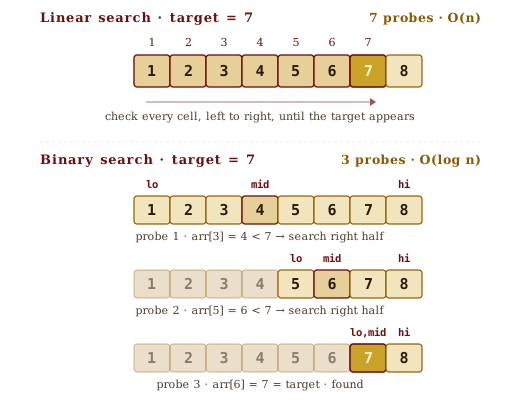
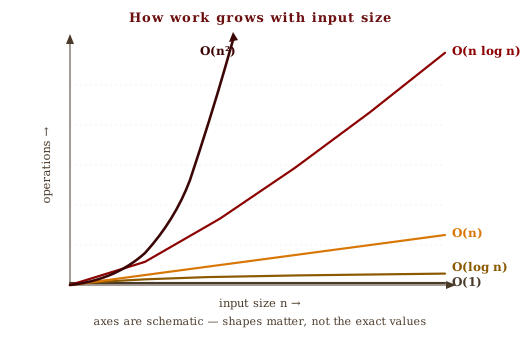
Then you learn to talk about how fast each one is — your first real encounter with Big-O notation — and you measure them yourself with a built-in benchmark.
Objectives
By the end of Floor 1 you will be able to:
- Implement linear search over a
std::vector<Monster>from scratch. - Implement iterative binary search over a sorted
std::vector<Monster>. - Implement recursive binary search using a private helper that carries the search range.
- State, without looking, the Big-O of each:
O(n)andO(log n). - Explain — in your own words and with an example — why binary search requires a sorted input, and what goes wrong if you skip that step.
- Read a benchmark table and identify the input size at which
O(log n)clearly beatsO(n).
Pre-class
Reading (ZyBook Ch. 2)
Before Monday: §2.1 Searching and algorithms (covers linear search) Before Wednesday: §2.2 Binary search; skim §2.3 Growth of functions and complexity (focus on Big-O, not Big-Ω/Big-Θ) Before Friday: §2.4 Constant time operations; §2.5 O notation; §2.6 Algorithm analysis; §2.7 Recursive definitions; §2.8 Recursive algorithms (the recursive binary search example is the punchline); §2.9 Time complexity of recursive algorithms (skim — recurrence relations are not on this week’s exam)
Yes, that’s a lot. The §2.4–2.6 material on Big-O is short and largely redundant; read for fluency, not depth. Recursion (§2.7–2.9) is a first pass — you’ll see it again on Floor 4½ and use it heavily on Floors 8–9.
Work the Question Sets and Animations inside the ZyBook — they count toward your participation grade.
There are no pre-class videos. Class time is for live coding and discussion together — your reading is the prep.
In-class (MWF)
| Day | Focus | Activity |
|---|---|---|
| M | Linear search | Live-code linearSearch together against the 15-entry bestiary; pair-debug an off-by-one I plant in the loop; commit it to your project |
| W | Iterative binary search + Big-O | Guess my number warmup; live-code iterative binarySearch on the sorted bestiary; derive O(n) vs O(log n); finish with the question “what if the list isn’t sorted?” |
| F | Recursion + the benchmark | Walk through binarySearchRecursive together — same algorithm, recursive form; introduce the helper-function pattern; everyone runs benchmark and we read the table together; class discussion of growth curves |
The project — Floor 1
This week’s project increment is the entire search and benchmark machinery.
You will receive (in your starter drop):
- A
Monsterstruct withname,hp,attack,weakness. - A
Bestiaryloader that readsdata/monsters.txtinto astd::vector<Monster>. - The CLI wired so that
search <name>calls into a function you write:findMonster(...), which delegates to one of the three searches. - A header
bestiary/Search.hdeclaring the four functions you need to implement. - A
benchmarkcommand, fully implemented, that times all three of your searches against synthetic bestiaries from N=10 up to N=100,000.
You will write (in bestiary/Search.cpp):
- Monday:
linearSearch - Wednesday:
binarySearch(iterative) - Friday:
binarySearchRecursive - Friday:
findMonster— pick whichever you want the rest of the game to use; defend your pick in your commit message.
Demo target (Friday):
> search Goblin
Goblin   HP 8   ATK 2   weakness: fire
> search Ghost
No such creature stalks this Keep.
> benchmark 10000
  N=  10000  query=last    linear=   42.1 us  binary=  0.10 us  recursive=  0.13 us
  N=  10000  query=absent  linear=   45.3 us  binary=  0.10 us  recursive=  0.13 us
(Search is case-sensitive this week. Try search goblin lowercase and notice it fails — we will handle case in a later floor.)
Lab 1 — Race the Bestiary (folded into the project)
There is no separate lab handout. The benchmark command IS the lab.
Commit floor-01/lab-notes.md to your project repo with:
- The full
benchmarkoutput (paste from your terminal). - At what bestiary size does binary search start to clearly beat linear? Read your table; pick a row.
- For N=10, which is faster, and why might that surprise a beginner?
- What happens if you call
binarySearchon the unsorted bestiary? Try it: comment out thesortBestiary(bestiary);call inmain.cpp, rebuild, search a few names. RestoresortBestiarywhen done. Write what you saw and why. - Iterative vs. recursive — do their per-call times differ in your benchmark? By how much? Why?
Your commit history this week should show at least three commits — Mon (linear), Wed (iterative binary), Fri (recursive + lab notes).
Bestiary · Floor 1
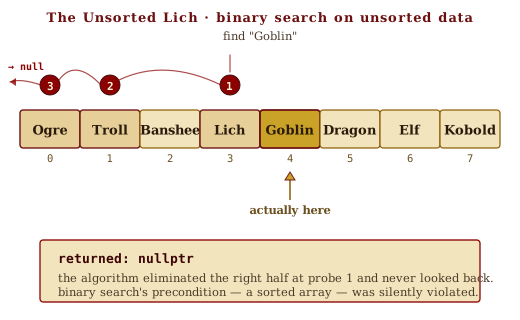
The Unsorted Lich — HP: invisible. Damage: silent.
Strikes when you call binarySearch (or binarySearchRecursive) on a list that is not sorted. Returns nullptr for things that are in the bestiary. Returns a wrong-but-plausible monster for things that aren’t. Never crashes. Never errors. Just lies.
nullptr.Counter by:
- Sorting the bestiary before the first binary call (
std::sortworks fine here). - Writing an
assert(isSorted(bestiary))at the top ofbinarySearchwhile you are learning. Remove it later if you must, but never if you are unsure. - Knowing in your bones:
linearSearchalways works.binarySearchworks only if you uphold its precondition.
Check for understanding
Before you descend to Floor 2, you should be able to answer these without looking:
- What is the worst-case Big-O of linear search? Of binary search? Why?
- Binary search is faster, so why would anyone ever use linear search?
- You call
binarySearchon an unsorted bestiary and it returnsnullptrfor “Goblin” even though “Goblin” is in the list. Explain exactly why, in terms of the algorithm’s steps. - If your bestiary doubles in size from 1,000 to 2,000 monsters, how many more comparisons does linear search do in the worst case? How many more does binary search do?
- Iterative and recursive binary search have the same Big-O. Why might the iterative version still be a better default in production code?
- In our codebase,
findMonsteris the one place the rest of the game asks “is this monster in the bestiary?” Why is that a good design — i.e., what would change in Week 11 if every place in the game called the search function directly?
Answers are discussed in the Monday Floor 2 warmup.
The Well is dark and waiting. Speak a name. The stair to Floor 2 — the Sorting Crucible — opens only once you can find what you are looking for.