The Sorting Crucible

Order is not given to the world. Order is hammered into it.

Master Foust, met on the landing between floors
Friend! Before you walk into a forge on an empty pack — a scroll. Pivots, three for a copper. Pick the wrong one and your sort takes a thousand times longer; pick the middle and you live. The Order won’t tell you which to pick. I will. Two coppers.
The briefing
You step from the Scrying Well’s chamber onto a stair of black iron and descend until the air smells of hot metal. The room beyond is round, low-ceilinged, and lit by a single forge in the center — the Crucible. Heaped on the floor around it are your trophies from Floor 1: the loot you collected and never bothered to organize.
Last week, the Well showed you that binary search demands sorted data. The Bestiary was sorted for you before you ever touched it. The Crucible asks the harder question: what if no one sorts it for you?
This week you build the sorting. By Friday your hero will be able to type sort inventory by weight — or by name desc, or by value — and watch the heap re-arrange itself. You will write two sorting algorithms by hand, then learn the C++ way to ask for one (std::sort) and the comparator pattern that makes it bend to whatever order you want.
You will learn three sorts:
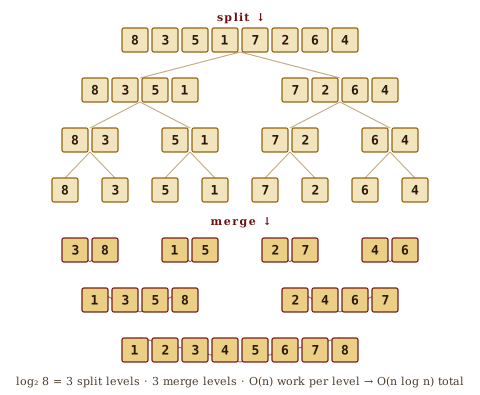
- Merge sort — the canonical divide-and-conquer sort. Split the vector in half, sort each half (recursively!), then merge the two sorted halves. Predictable
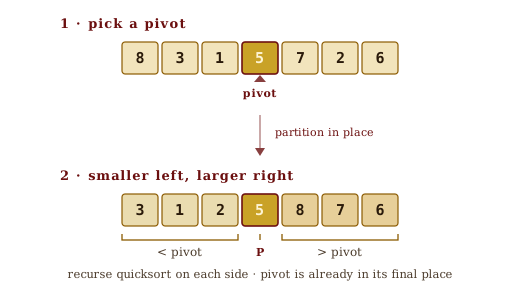
O(n log n). Stable. Allocates a scratch buffer. - Quicksort — also divide-and-conquer, but the work is in the split, not the merge. Pick a pivot, partition into “less than pivot” and “greater than pivot,” recurse on each side. Average
O(n log n), in-place, ferociously fast in practice — but a bad pivot can degrade it toO(n²). std::sort— what production C++ actually reaches for. Not a single algorithm: it’s a hybrid (introsort) tuned by people who think about cache lines for a living. You don’t write it; you learn to aim it with a comparator.
Then you race them. The benchmark from Floor 1 grows a sorting harness, and you watch the three curves on real data.
Objectives
By the end of Floor 2 you will be able to:
- Implement merge sort on a
std::vector<Item>from scratch, including the merge step. - Implement quicksort on a
std::vector<Item>from scratch, including a partition step around a pivot. - Pass a comparator (a function or lambda) to
std::sort, yourmergeSort, and yourquicksortso that one sorting routine produces multiple orderings. - State the average and worst-case Big-O of merge sort and quicksort, and explain why quicksort can degrade.
- Define stable and in-place sorting, and identify which of the three you wrote (or used) is which.
- Read a benchmark table and identify the input size at which
O(n log n)clearly beatsO(n²)— or at whichstd::sortclearly beats your hand-rolled implementations.
Pre-class
Reading (ZyBook Ch. 3)
Before Monday: §3.1 Sorting: introduction; §3.5 Merge sort Before Wednesday: §3.4 Quicksort Before Friday: §3.8 Overview of fast sorting algorithms; skim §3.2 Selection sort and §3.3 Insertion sort (we will not implement them, but you should be able to recognize them and say why they’re slow)
The book also covers Shell sort (§3.6) and Radix sort (§3.7). Both are interesting; neither is on this week’s exam. Read for curiosity, not for grade.
Work the Question Sets and Animations inside the ZyBook — they count toward your participation grade. The Animation in §3.5 is the best 90 seconds you will spend this week.
There are no pre-class videos. Class time is for live coding and discussion together — your reading is the prep.
In-class (MWF)
| Day | Focus | Activity |
|---|---|---|
| M | Divide-and-conquer + merge sort | “Sort yourselves alphabetically by first name” warmup; live-code mergeSort and merge together; watch it sort the inventory; commit |
| W | Quicksort + the pivot question | Live-code partition and quicksort; demo a bad pivot on already-sorted input and watch it degrade; discuss why std::sort doesn’t pick first-element pivots |
| F | Comparators + std::sort + race the sorts |
Add the <criterion> parameter; pass lambdas to all three sorts; run benchmark sort and read the table together; class discussion of when you’d reach for which |
The project — Floor 2
This week’s project increment is the sort inventory command and the underlying machinery.
You will receive (in your starter drop):
- An
Itemstruct withname,weight,value. - A
Herowhose inventory is astd::vector<Item>(already populated with starting loot). - The CLI wired so that
sort inventory by <criterion>calls into a function you write:sortInventory(...), which dispatches to one of the three sorts. - A header
hero/Sort.hdeclaring the functions you need to implement. - A
benchmark sortcommand, fully implemented, that timesmergeSort,quicksort, andstd::sortagainst synthetic inventories from N=10 up to N=100,000.
You will write (in hero/Sort.cpp):
- Monday:
mergeSortand the helpermerge. - Wednesday:
quicksortand the helperpartition. - Friday:
sortInventory— read the criterion string, build the right comparator, dispatch to whichever sort you want as the default, and defend your pick in your commit message.
Demo target (Friday):
> inventory
  1.  Rusty sword       (wt 4.0, val 5)
  2.  Healing potion    (wt 0.5, val 12)
  3.  Iron key          (wt 0.1, val 0)
  4.  Loaf of bread     (wt 0.1, val 1)
  5.  Cloak of shadows  (wt 1.5, val 80)
> sort inventory by weight
  1.  Iron key          (wt 0.1, val 0)
  2.  Loaf of bread     (wt 0.1, val 1)
  3.  Healing potion    (wt 0.5, val 12)
  4.  Cloak of shadows  (wt 1.5, val 80)
  5.  Rusty sword       (wt 4.0, val 5)
> sort inventory by name desc
  1.  Rusty sword       (wt 4.0, val 5)
  2.  Loaf of bread     (wt 0.1, val 1)
  3.  Iron key          (wt 0.1, val 0)
  4.  Healing potion    (wt 0.5, val 12)
  5.  Cloak of shadows  (wt 1.5, val 80)
> benchmark sort 10000
  N=  10000  mergeSort=  1.20 ms  quicksort=  0.95 ms  std::sort=  0.62 ms
Try sort inventory by weight twice in a row and notice nothing visibly changes — that’s correct. A sort is idempotent on already-sorted data. (Not free, though — that’s a Friday discussion.)
Lab 2 — Race the Sorts (folded into the project)
There is no separate lab handout. The benchmark sort command IS the lab.
Commit floor-02/lab-notes.md to your project repo with:
- The full
benchmark sortoutput (paste from your terminal). - At what inventory size does
std::sortclearly pull ahead of your hand-rolled sorts? Read your table; pick a row. - Run the benchmark with a pre-sorted input (the harness has a
--sortedflag). Which sort gets faster? Which gets slower? Why? - Quicksort with a first-element pivot on a sorted input — try it. (The harness has a
--bad-pivotflag.) Time it on N=10,000. What does the curve look like? Show your work. - One-paragraph reflection. If you could only ship one of the three sorts in production, which would you ship? Defend your choice in terms of worst case, average case, and what the data is likely to look like.
Your commit history this week should show at least three commits — Mon (merge), Wed (quick), Fri (std::sort + lab notes).

Grix the Opportunist offers his strategy
Easy, friend! You take the first one in the line — that’s your pivot. Always works for Grix. Why pick a middle? You don’t even know what’s in the middle yet! First one, every time. Sorted.
Bestiary · Floor 2
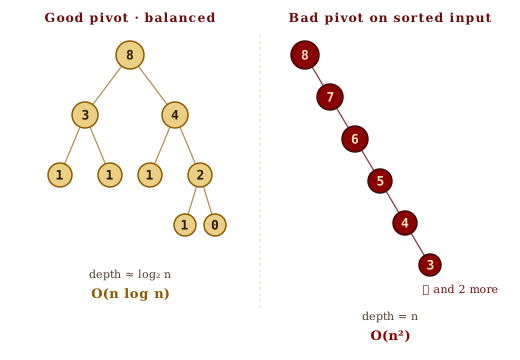
The Pivot Wraith — HP: situational. Damage: silent and slow.
Strikes when you call quicksort with a fixed-position pivot (always-first, always-last) on data that is already nearly sorted. Your O(n log n) average case becomes O(n²) worst case — no crash, no error, just a sort that takes a thousand times longer than it should and a benchmark you can’t explain.
Counter by:
- Picking the middle element as the pivot for this week’s hand-rolled
quicksort— it sidesteps the trivial sorted-input pathology. - Knowing in your bones: average case is what your data probably looks like; worst case is what an attacker, or a bad day, will hand you. A real
std::sortswitches algorithms when it detects bad recursion depth (introsort). Yours does not. - When in doubt, reach for
std::sort. It is faster and meaner than anything you will write this week.
Check for understanding
Before you descend to Floor 3, you should be able to answer these without looking:
- What does divide-and-conquer mean? Name two algorithms that use it (one you wrote this week, one you wrote last week).
- Merge sort is
O(n log n)always. Quicksort isO(n log n)on average. Why isn’t quicksort alwaysO(n log n)? - Define stable sort in one sentence. Suppose
Iron key(wt 0.1) appears beforeLoaf of bread(wt 0.1) in your inventory. After a stablesort by weight, which appears first — and what does an unstable sort fail to guarantee about those two? (Hint: this is why to get weight-primary, name-tiebreak order you sort by name first and then stably by weight — not the other way around.) - Define in-place sort. Which of {merge sort, quicksort, std::sort} are in-place?
- A comparator is a function (or lambda) that returns true if
ashould come beforeb. Why does taking a comparator let one sort routine produce every possible ordering of your items? - In our codebase,
sortInventoryis the one place the rest of the game asks “put these items in order.” Why is that a good design — i.e., what would change in Week 11 (when the inventory becomes a balanced tree) if every command sorted directly?
Answers are discussed in the Monday Floor 3 warmup.
The Crucible’s forge dies down to embers. Your inventory is sorted. The stair to Floor 3 — the Forgemaster’s Vault — opens only once you can put your house in order.