The Forgemaster's Vault
One mold. Every chest. Every monster. Every name.
The briefing
The stair from the Crucible’s cooling embers descends into a vaulted stone chamber of empty racks, cold crucibles, and brass molds — the Forgemaster’s Vault. In the center stands the Forgemaster, silent, a hammer at his belt. He turns and speaks.
Forgemaster Steil, Master of the Cold Forge
You have sorted your spoils. But look at the racks — your inventory, the keep’s bestiary, the spellbook yet to come. Three lists. Three shapes. Three separate codes. A waste. This week we press one mold. Stamp it for Items. Stamp it for Monsters. And when a caller asks for steel that is not in the chest — the forge does not crack. It cries out. The game above hears, and recovers, and continues.
Last week you sorted. This week you build the container shape that stamps out a list for any kind of thing. By Friday, your hero’s inventory and the keep’s bestiary will both live inside a Bag<T> — one class template you wrote, instantiated twice. From the outside, nothing changes. From the inside, one piece of code does the work of two.
You will learn two things, and they are inseparable:
- Templates — one mold, any metal. Write
Bag<T>once; the compiler stamps a fresh copy for everyTyou instantiate. Function templates first (findByName<T>generalizes Floor 1’s linear search); class templates next (Bag<T>replaces bothstd::vector<Item>andstd::vector<Monster>). - Exceptions — when a caller asks for
inventory.at(999)on a five-item bag, what does the function return? Nothing sensible. It throws aBagException. The main loop catches. The game keeps going. The caller knows exactly what went wrong.
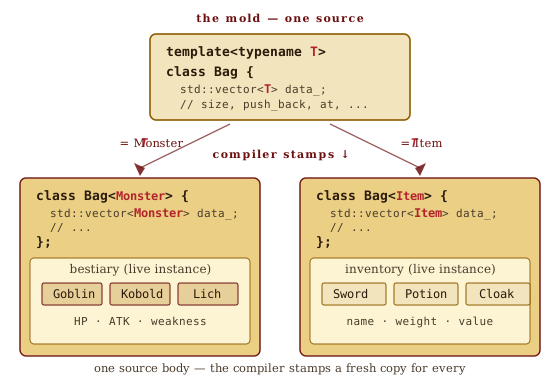
Bag<T> once; the compiler presses a fresh class for every T you instantiate — Bag<Monster> for the keep's bestiary, Bag<Item> for the hero's inventory.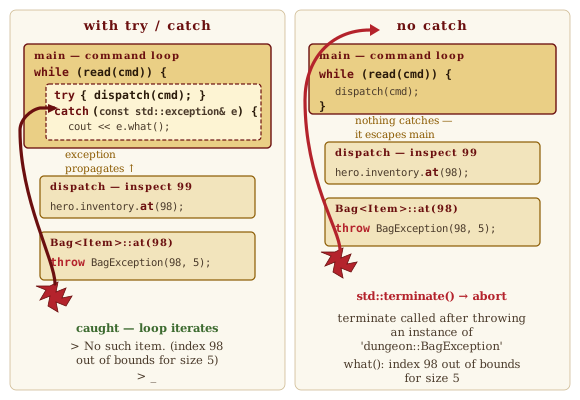
inspect 99 throws deep inside Bag::at. With try/catch in main, the exception unwinds up the call stack into the handler and the command loop continues. Without a catch, the exception escapes main, the runtime calls std::terminate, and the program aborts.You are not rewriting std::vector this week — Bag<T> is a thin wrapper over it. The point is the template machinery, not the storage.
Objectives
By the end of Floor 3 you will be able to:
- Write a function template from scratch —
template<typename T> const T* findByName(const Bag<T>&, const std::string&). - Write a class template from scratch —
template<typename T> class Bag. - Instantiate the same class template with two different types in the same program and point to where the compiler stamped each copy.
- Define a custom exception that inherits from
std::exceptionand overrideswhat(). - Distinguish
operator[](no bounds check, fast) fromat()(bounds check, throws). - Catch a thrown exception at the right level; predict what happens if the exception escapes
main. - Read a wall-of-text template compiler error and locate the one line that actually tells you what went wrong.
Pre-class
Reading (ZyBook Ch. 4 & 5)
Before Monday: §4.1 Function templates; §4.2 Class templates
Before Wednesday: §4.3 C++ example — map values using a function template (the worked example ties Monday and Wednesday together)
Before Friday: §5.1 Handling exceptions (try / catch); §5.2 Throwing exceptions; §5.4 User-defined exceptions; skim §5.5 (a second worked example)
You can skip §5.3 (exceptions with files) — we do not touch files this week.
Work the Question Sets and Animations inside each section. The §4.2 animation of a class template being stamped for two different types is exactly what will happen to Bag<T> on Wednesday — watch it twice.
There are no pre-class videos. Class time is for live coding and discussion together — your reading is the prep.
In-class (MWF)
| Day | Focus | Activity |
|---|---|---|
| M | Function templates | Live-code a generic findByName<T> together. Replace Floor 1’s monster-only linearSearch with the template. Call it on the bestiary and on the hero’s inventory — same source line, two stampings. Watch the compiler error when we call it on a Bag<int>. |
| W | Class templates | Live-code Bag<T> from the starter declaration. Rewrite Hero.h so the inventory is Bag<Item>; rewrite the bestiary to be Bag<Monster>. Commit when inventory, bestiary, search, and sort inventory all run off one class template. |
| F | Exceptions | Write BagException : public std::exception. Make at() throw on bad index. Wrap the main command loop in try/catch. Plant a deliberate bad call — watch the game not crash. Discussion: what must not go in a catch block, and why catch(...) { } is worse than no catch at all. |
The project — Floor 3
This week’s project increment is one container shape shared across the whole game.
You will receive (in your starter drop):
- Everything through Floor 2, fully working —
search,sort inventory by <criterion>, all three benchmarks from Floor 1 and Floor 2. - A header
hero/Bag.hwith the class template declaration —template<typename T> class Bag, privatestd::vector<T>member, and signatures for every method you need to implement. - A header
hero/BagException.h— a user-defined exception derived fromstd::exceptionwith awhat()message. - A header
hero/Search.hwith the newfindByName<T>function template declaration (Floor 1’s monster-specific version is still there for comparison, marked deprecated). hero/Hero.hupdated so the inventory isBag<Item>;bestiary/Bestiary.hupdated so monsters live inBag<Monster>. Every existing command stops compiling until Monday’s work is in. That is intentional.
You will write:
- Monday:
findByName<T>inhero/Search.h(templates live in headers). Rewiremain.cpp’ssearchcommand to call the template. Demonstrate calling it on bothBag<Monster>andBag<Item>from different commands. - Wednesday:
Bag<T>—push_back,size,empty,operator[],begin/end(delegate to the underlyingstd::vector),clear. When this is done,inventory,sort inventory, andsearchall run through it. - Friday:
BagException,Bag<T>::at()that throws on bad index, and atry/catcharound the main command dispatch inmain.cpp. A badinspect 99must print a clean error and return to the prompt.
Demo target (Friday):
> inventory
  1.  Rusty sword       (wt 4.0, val 5)
  2.  Healing potion    (wt 0.5, val 12)
  3.  Iron key          (wt 0.1, val 0)
  4.  Loaf of bread     (wt 0.1, val 1)
  5.  Cloak of shadows  (wt 1.5, val 80)
> bestiary
  1.  Goblin            HP 8   ATK 2   weakness: fire
  2.  Kobold            HP 5   ATK 1   weakness: cold
  3.  Lich              HP 30  ATK 6   weakness: radiant
  ...
  (same Bag<T> — different T)
> search Goblin
  Goblin   HP 8   ATK 2   weakness: fire
> search "Iron key"
  Iron key          (wt 0.1, val 0)
  (same findByName<T>, two instantiations)
> inspect 99
  No such item. (BagException: index 99 out of bounds for size 5)
  (game keeps running — the catch block handled it)
> sort inventory by weight
  (still works — now running on your Bag<Item>)
Lab 3 — One Mold, Many Shapes (folded into the project)
There is no separate lab handout. The work you do this week is the lab.
Commit floor-03/lab-notes.md to your project repo with:
- A transcript of the demo above. Paste it from your terminal.
- Instantiate
Bag<int>in a throwaway test and callfindByNameon it. Paste the full compiler error. Circle (or describe) the one line that actually tells you what’s wrong. Why is this harder to read than a normal type error, and what does that tell you about templates? - Swap
at()foroperator[]in theinspectcommand. Pass a bad index. Describe what the program does now — does it crash? Print garbage? Silently return? Restoreat()when done. One-sentence answer: when would you ever wantoperator[]overat()in production? - Remove the
try/catcharound the main loop. Trigger a badinspect. Describe exactly what you see on stderr (the unhandled-exception message the runtime prints beforestd::terminate). Put the catch back. Then try the anti-patterncatch(...) { }— empty body — and describe what is now worse than having no catch at all. - Change
BagExceptionso it does NOT inherit fromstd::exception. What still compiles? What behavior (if any) do you lose? One sentence on why inheriting fromstd::exceptionis the right default.
Your commit history this week should show at least three commits — Mon (function template), Wed (class template), Fri (exceptions + lab notes).
Grix the Opportunist shares another trick
Best trick I ever learned, friend! When the program shouts at you — catch(...) { }. Empty inside. No words! The shouting stops. No more errors. No more crashes. You’re welcome.
Bestiary · Floor 3
The Swallowed Scream — HP: ∞. Damage: invisible, cumulative.
Strikes when a programmer, panicked by a crash, wraps bad code in catch(...) { } to make the error “go away.” The program no longer crashes. It also no longer works. Bugs are no longer reported. The inventory command silently does nothing half the time. A boss fight ends with the player at zero HP and no message. The Swallowed Scream does not kill you. It removes your ability to notice that something is killing you.
Counter by:
- Catch at the level where you can actually do something about it. The main command loop can say “command failed: {what}” and return to the prompt. A two-line helper in the middle of a subsystem usually cannot — let the exception propagate.
- Never write
catch(...) { }with an empty body. At a minimum, log. Better: rethrow after logging. Best: don’t catch at this level at all. - Inherit from
std::exception. The catch block can then aske.what()and print something useful. A rawthrow 42;is technically legal C++ and produces an error message a caller cannot read.
Check for understanding
Before you face the first boss, you should be able to answer these without looking:
- What does
template<typename T>buy you that a non-templated class doesn’t? Give a concrete example from this week: one class, two instantiations, both appearing in the same program. - Where does
Bag<T>’s code have to live —Bag.horBag.cpp? Why? - Your function template uses
x.namesomewhere inside its body. You instantiate it withT = int. At what point do you find out there’s a problem — writing the code, compiling, or running? Why? operator[]does not bounds-check;at()does and throws. Give one situation in the game where you’d reach for each.- Your custom exception inherits from
std::exceptionand overrideswhat(). What would change if it didn’t inherit from anything — what still works, and what becomes awkward for the caller? - A thrown exception is not caught anywhere before it reaches
main. What does the C++ runtime do? Demonstrate in your lab notes, and explain in one sentence why that default behavior is actually good — i.e., what it forces you to do.
Answers are discussed at the start of Floor 4 — but first, Midterm 1 stands between you and Floor 4. The boss tests Floors 0 – 3 together. Prepare for it.
The Forgemaster sets down his hammer. The mold cools. One forge has stamped two containers, and when the forge is asked for steel that isn’t there, it cries out instead of cracking. Above the far door the first warden stirs — the Boss of the Foundations — where every lesson from the Antechamber through the Vault is put to the test. Pass, and the stair to Floor 4 — the Chain Vault — opens.