The Warden of the Foundations
Four floors built you a hero. The Warden waits for the hero to use what was built.
The gate
Steil’s forge has gone cold behind you. Ahead, a vaulted antechamber — empty but for a single shape standing at its centre, and a closed gate beyond it. On the far side of the gate, you can hear Foust’s cart-wheel; Floor 4 is on the other side.
The shape does not move yet. It has no face you can name. It is the Warden of the Foundations — the first of four — and it does not bring a fifth lesson. It brings every one of the four above, and asks whether they took. To prove they did, you will study, you will critique, and at the end, you will fight it inside the game you have been building.
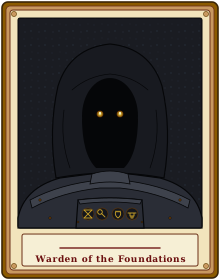
The Warden, who has no name to give
Read. Critique. Build me into your game — and then strike me. Three trials, and an encounter. Pass them all, or do not pass.
This page is your Midterm 1. It replaces the timed paper exam. It is in two parts: a take-home gauntlet of three trials committed to your project repo, the third of which is a working boss battle inside your dungeon app; and a short in-class quiz on Friday that ties your submission to your own hand. Together they are 100 % of the midterm.
The schedule
| Phase | When | What |
|---|---|---|
| Gauntlet opens | Friday, end of Week 4 — after Floor 3’s last class | The three trials below become available. Begin any time. |
| Gauntlet closes | Friday of Week 5, 9:00 AM | All artifacts and battle code committed and pushed to your project repo. |
| In-class quiz | Friday of Week 5, during class | ~20-minute paper quiz — every question pulled from your own battle code. |
| Grades returned | Following Wednesday | Per-trial rubric notes + total. |
Plan your week. Trials I and II can be knocked out in an evening each. Trial III — the boss battle — is real engineering work and will take you several focused sittings. Start it early.
Brother Faith stands with you at the gate
I am not going to make you race a paper exam under my stopwatch. I am going to ask you to use what these four floors gave you — in the game you have been building, against the Warden in front of you. Search. Sort. Stamp. Catch. If those four words live in your fingers by Friday, you will pass. If they live only in your notes, the Warden will see it the moment you step on the floor.
AI policy for this midterm — read once, follow always
You may use AI assistants (Claude, Copilot, ChatGPT, the in-IDE completion in your editor — anything) on every trial below. Trial II requires you to use one. The rules are:
- Declare what you used, where. Submit an
AI-USE.mdin yourwarden-trials/folder. For each trial, write one or two lines: which tool, what you asked it for, what you did with the result. “Did not use” is a perfectly good entry — but the line must be there. - The artifact must survive a conversation about it. Friday’s quiz will pull questions directly from your battle code in your own handwriting. If you turned in something you cannot defend, you submitted it from the wrong author.
- Submitting AI output as-is, undeclared, is the failure mode — not the AI use itself. Reading, running, fixing, and understanding AI output is engineering. Pasting and shipping is not.
- Trial II is explicit: you will engage an LLM, paste the prompt and response, and write a critique.
- Trial III adds one constraint: in your
encounter-notes.md, name two functions in your battle code that you wrote without AI assistance — by hand, with no autocomplete on the body. These are the functions Friday’s quiz can ask you to modify on paper, so pick ones you actually understand cold.
This policy is the same one your future employer will write next year. Practice now.
The three trials
Run them in order. Trials I and II are short prep that prove your foundations are sound. Trial III is where you put them to work.
Trial I — The Foundations Brief (15 %)
The Warden wants four short answers — one from each floor above, each one anchored to the battle you are about to build. No code on this trial; just clear thinking on paper-or-keyboard.
Do. Open floor-03/warden-trials/trial-1-brief.md and write 50–100 words per answer:
- (Floor 0 — ADT.) Your battle’s “Use item” menu shows the currently usable items in your hero’s inventory on this turn. Name the right ADT for that menu. Defend the choice against its closest neighbour (e.g., why
baginstead ofset, orlistinstead ofbag). - (Floor 1 — search & Big-O.) Your inventory is kept sorted by healing power. The player types
use Healing potion. Linear or binary search to find it by name? Justify, and give the Big-O for each. - (Floor 2 — sort & comparators.) Your “Use item” menu must be displayable sorted either by healing power or by weight. Show a one-line comparator (lambda) for each. One sentence on what language feature makes one
std::sortcall serve both orders. - (Floor 3 — templates & exceptions.) Why does
Bag<T>live inBag.hinstead ofBag.cpp? And: when the player types9for a 4-option menu, where in your code should the validation throw, and where should it catch?
Submit. trial-1-brief.md.
Full credit. Four answers, each tight and correct. AI is welcome to check your answers; AI cannot write your sentences — these are short enough that we will recognise the LLM voice.
Trial II — The Critique (15 %)
You will engage an LLM, save the conversation, and critique what it gave you. This is the AI-literacy trial: reading and judging AI code is now part of the job.
Do. In floor-03/warden-trials/trial-2-critique.md:
- Open Claude (or your LLM of choice). Paste this exact prompt:
Write a C++ function template that returns the largest element of a
std::vector<T>. Handle the case where the vector is empty. Briefly explain your design choices. - Paste the prompt and the LLM’s full reply into
trial-2-critique.md. - Below the reply, write a critique of at least 150 words addressing:
- Does the code compile? Did you try it?
- What does the empty-vector case actually do? Is the LLM’s choice reasonable?
- What does this require of
T? What happens if you instantiate it with a type that doesn’t support<? - Const-correctness — by value or by reference? Would you change either?
- Did the LLM cheat by using
std::max_element, or did it write the loop? Which would you have shipped, and why? - One concrete improvement you would make before merging this into a real project.
Submit. trial-2-critique.md.
Full credit. A critique that reads like an engineer reviewing a colleague’s pull request — specific, technical, and naming what the LLM did. A vague critique is not full credit even if the LLM’s code was great.
Trial III — The Encounter (60 %)
This is the trial. You will program the Warden of the Foundations into your dungeon app as a real, playable boss battle, and you will fight it.
Do. In your floor-03 project (the one you’ve been building all term), add a battle warden command to main.cpp (factor it into a Battle.h / Battle.cpp if you like — encouraged but not required). When the player types it, the encounter begins.
Required mechanics — minimum viable:
- Stats. Player starts at 30 HP. Warden starts at 50 HP. (Numbers are yours to tune; document them.)
- Turn loop. Each turn: print current state (both HPs, last action), present a numbered menu, read input, execute, repeat.
- Menu — at least four options:
- Attack — deal damage to the Warden. Warden retaliates the same turn.
- Use item — pick from your inventory; apply effect; turn ends.
- Inspect Warden — print the Warden’s HP and one of its sigils as a hint (free action — turn does not end).
- Flee — leave the encounter. The Warden does not chase; the gate stays closed.
- Win condition. Warden HP ≤ 0 → print a victory message and the gate opens.
- Lose condition. Player HP ≤ 0 → print a defeat message; the run ends.
Required ties to Floors 0 – 3 — every one of these must be present in your battle code, real and load-bearing (not pasted in for show):
- Floor 0 (ADT): the available menu actions for the current turn must be held in a container of your choice. In a comment above the declaration, name the ADT and defend it in one sentence — exactly the reasoning from Trial I.
- Floor 1 (search): the “Use item” branch must call
findByName<Item>(your Floor 3 function template) on the hero’s inventory to look up the item the player typed. - Floor 2 (sort): when the “Use item” menu is displayed, the inventory must be sorted first using
std::sortwith a comparator — by healing power, weight, value, your call — and the choice documented in a comment. - Floor 3 (templates + exceptions): invalid menu input (out-of-range number, unknown item name) must
throw BagException(or aBattleExceptionyou derive fromstd::exception). The throw must be caught inside the battle loop so the player gets a clean error and another menu prompt — not a crash, not an exit. The player’s inventory must remain aBag<Item>.
Also required:
- A short
floor-03/warden-trials/encounter-notes.mdwith:- Your AI declaration for this trial (per the policy).
- The two functions you wrote without AI, named by file and line. Friday’s quiz can pull from these.
- One paragraph (≤ 200 words) reflecting on the integration: which Floor’s tie was hardest to wire in, and why.
- A working build. We will
cmake --build buildyour project. If it does not compile, the Warden has won by default.
Submit. Your modified main.cpp (and any Battle.{h,cpp} you added) + encounter-notes.md, all committed to your project repo.
Full credit (rubric inside the 60 %):
| Sub-component | Pts |
|---|---|
| Battle compiles and plays through (menu, both endings reachable) | 25 % |
| All four Floor 0 – 3 ties present and meaningful | 25 % |
| Encounter notes complete (AI declaration + two no-AI functions named + reflection) | 5 % |
| Code quality (readable, factored, no copy-paste fog) | 5 % |
The Warden’s Question — Friday in-class quiz (10 %)
Twenty minutes. Closed everything — no books, no laptops, no phones, no AI. You will receive four short paper questions, each one a small modification to your own submission. Three of the four will pull from the two functions you named in encounter-notes.md as written-without-AI. Examples:
- “Modify your
attackWardenfunction so the player’s attack damage scales with their remaining HP. On paper, write the changed lines.” - “In your battle’s menu loop, add a ‘Defend’ option that halves the Warden’s next attack. Sketch what changes.”
- “Your inventory comparator currently sorts by healing power. Rewrite it on paper to sort by healing-per-weight.”
If you wrote your battle, this quiz takes ten minutes. If you didn’t, it takes the full twenty and the gap is what we grade.
The quiz is the integrity seal. It is short by design and intentionally tied to your own submission — not because we don’t trust you, but because by Friday you will know your battle cold, and a quick conversation in your own handwriting is the cleanest proof of that.
Submission and grading
Submission. Commit and push the entire floor-03/warden-trials/ folder and your modified battle code to your project repo by 9:00 AM Friday of Week 5. Late commits drop one letter grade per day on the take-home portion.
Folder + code shape:
[your project repo]/
  floor-03/
    main.cpp                       <-- new `battle warden` command lives here
    Battle.h, Battle.cpp           <-- optional, encouraged
    hero/Bag.h, BagException.h     <-- already there from Floor 3 starter
    warden-trials/
      AI-USE.md
      trial-1-brief.md
      trial-2-critique.md
      encounter-notes.md
Rubric — top-level.
| Component | Weight | Full-credit shape |
|---|---|---|
| Trial I — The Foundations Brief | 15 % | Four tight 50–100-word answers in your voice |
| Trial II — The Critique | 15 % | ≥150-word substantive critique of the LLM’s reply |
| Trial III — The Encounter | 60 % | Working battle + 4 required Floor 0–3 ties + encounter notes (rubric above) |
| Friday in-class quiz | 10 % | Four short paper answers modifying your own battle code |
Steil, leaning on his hammer at the gate
When you write the battle, do not write it all at once. Write one turn — print, prompt, read, attack, retaliate. Compile. Run it. Then write the next move. Builders who write the whole forge before lighting the fire end up with a forge that does not light. The Warden knows this. So does any compiler that has shouted at you. Read the first line of every error message; ignore the rest until the first one is solved.
Bestiary · Warden of the Foundations
The Warden of the Foundations — HP: 50 (default). ATK: 4 per turn. Weakness: a hero who has actually used what the four floors taught. The first of four wardens. Cataloguers caught its silhouette but never its name; the page they pinned to its entry shows armour, four sigils, and two ember points where eyes should be. Below the figure, the name slot is struck through. The Warden fights at the strength of whichever floor you understand least — a hero who is strong on three floors and weak on one is a hero the Warden picks apart at the seam.
The Warden does not punish you for using your tools. It punishes you for letting your tools punish your understanding. A hero who wrote their battle with AI help, ran it, broke it, fixed it, named two functions they wrote alone, and can defend them on Friday — passes. A hero who pasted the whole battle from an LLM and shipped it without reading — does not.
You will fight this creature inside the game you wrote. That fact is the test.
Grix has a study tip
Friend! The boss battle — easy! Ask the machine to write the whole thing, paste it in, push it, do not fill in the AI form, name two random functions as “yours,” and on Friday — just look surprised. Look very surprised, friend! Works every time. (It does not work any time. Grix has tried. Grix’s hero has been at zero HP since Floor 1.)
The battle ends one way or the other — by Friday morning. The Warden does not announce the result; it falls, or you do. The judgement happens during Friday’s class, in handwriting, on modifications the Warden asks you to make to your own code. Beyond the gate, the stair to Floor 4 — the Chain Vault — descends into the dark. Foust is already there with his cart, sorting maps.